

Summary
- U.S. fire departments respond to an average of 3,840 construction site fires per year, causing $376 million in direct property damage and multiple fatalities annually.
- Most job sites still rely on perimeter-only camera systems that detect fire only after it becomes visible from the outside. By that point, the damage is done.
- The real problem is the “time gap,” the delay between when a fire starts and when someone knows about it. On many construction sites, that gap is measured in minutes or longer.
- Embedded sensor technology (such as wireless rate-of-rise heat detectors) paired with AI-powered cameras closes this gap by detecting temperature changes inside a structure within seconds.
- Recent deadly construction fires have pushed states to adopt stricter fire codes, but regulation alone won’t protect workers. On-site detection technology has to evolve.
Construction Sites Are Burning. The Detection Methods Haven’t Changed.
Did you know that on average 3,840 fires break out on U.S. construction sites every year.
That is roughly 10 per day, according to the NFPA’s report on fires in structures under construction (2013-2017 data).
These fires cause an estimated $376 million in direct property damage and an average of five civilian deaths annually on construction sites alone.
When you add fires at sites under major renovation, the numbers grow to $408 million in property damage, 12 civilian deaths, and 101 civilian injuries per year.
And yet, the fire detection systems on most job sites have barely changed in 30 years.
The standard approach? A few cameras mounted on poles around the perimeter. A monitoring service that watches video feeds. And a response protocol that depends on someone seeing flames on a screen before anyone takes action.
This article breaks down why that approach fails, what modern detection technology looks like, and what construction teams need to do to close the gap between when a fire starts and when someone responds.
What Is the “Time Gap” and Why Does It Cost Lives?
The time gap is the delay between when a fire ignites and when someone knows about it.
On construction sites, that gap is often the difference between a near-miss and a fatality.
Here is how the time gap plays out in practice:
Let’s say a piece of operating equipment generates enough heat to ignite nearby insulation material on the ground floor of a multi-story wood-frame building.
The fire starts small, but the structure has no drywall, no fire stops, and an open elevator shaft that acts as a chimney. Within minutes, fire has access to every floor.
Workers on upper floors may not know the fire has started. The building has no fire alarm system, because it has not been installed yet. There are no working sprinklers, because the standpipes are not connected. The only notification is when someone outside sees smoke or flames.
By that point, escape routes may already be compromised.
This is not a hypothetical.
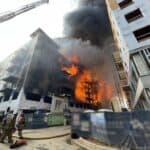
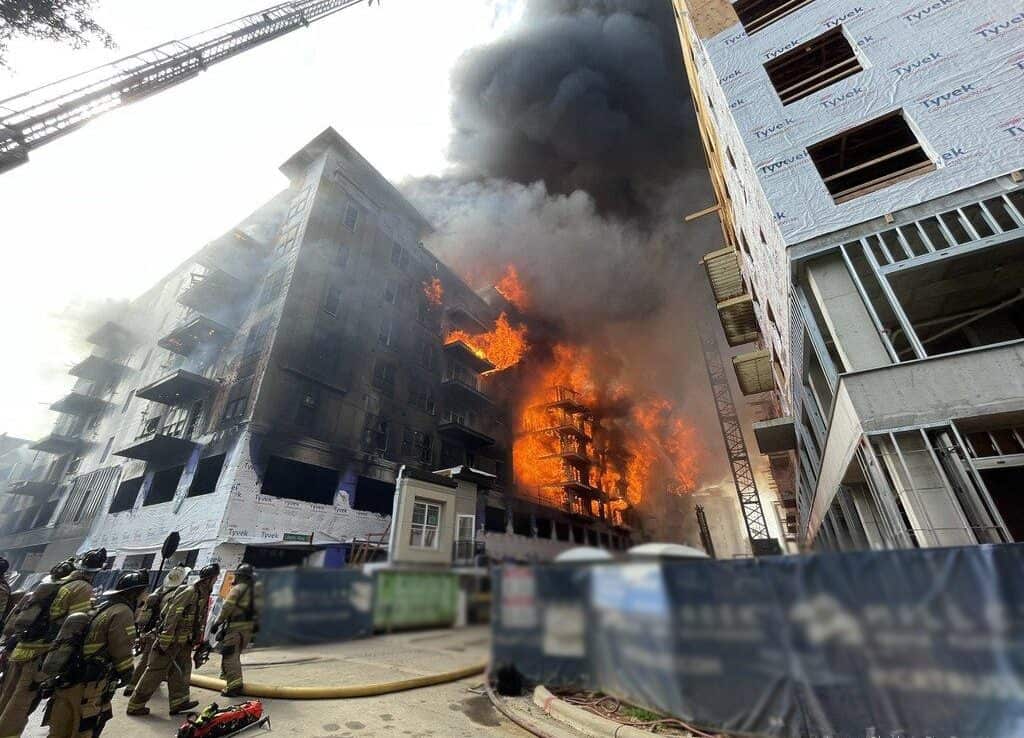
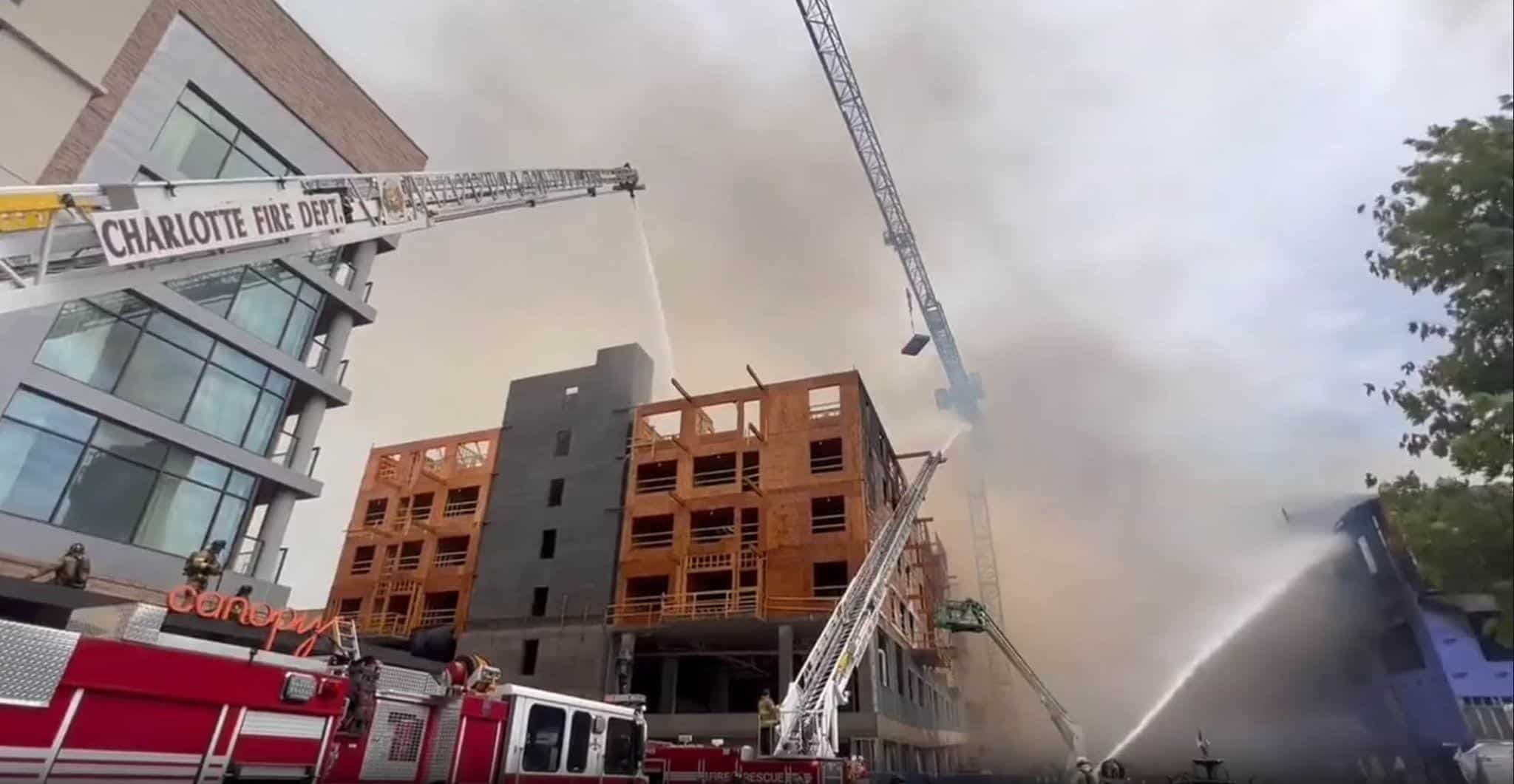
In May 2023, a five-alarm fire broke out at an apartment complex under construction in Charlotte, North Carolina’s SouthPark neighborhood. The fire started when heat from operating equipment ignited an insulation foam spray trailer on the ground floor. The open elevator shaft carried fire upward through seven stories of wood framing.
Over 90 firefighters responded. Fifteen workers were rescued. Two workers trapped on the sixth floor were not reached in time. Take a look at it below:
The fire department’s after-action report revealed that fire marshals never inspected the construction site.
There was no pre-fire safety plan. The standpipe system was not operational. Workers had no evacuation training.
“We were not called to come there and do an inspection,” Charlotte Fire Chief Reginald Johnson later told the city council. “The reality is we were never notified that vertical construction had even started in that building.”
Time was the central failure. Not the response time of firefighters, who acted heroically, but the detection time.
The gap between ignition and awareness.
If you shrink that gap from several minutes to several seconds, the entire outcome changes.
Workers get notified. Evacuation begins. Emergency services are dispatched before the fire becomes uncontrollable.
How Big Is the Construction Fire Problem?
Bigger than most people realize.
Buildings under construction are uniquely vulnerable to fire for a handful of overlapping reasons.
Fire suppression systems (sprinklers, alarms, standpipes) are not installed or operational until late in the construction process.
The structures themselves are often open, unfinished, and filled with combustible materials like wood framing, insulation, and adhesives. And the very work being performed on site, welding, cutting, grinding, and equipment generating heat, introduces constant ignition sources.
According to the NFPA’s Construction Site Fire Safety Fact Sheet, the most common risk factors include:
| Risk Factor | Why It Matters |
| No active fire suppression | Sprinklers and alarms are not operational during construction |
| Open structure design | No drywall, no fire stops, no compartmentalization to slow fire spread |
| Combustible materials on site | Wood framing, insulation foam, adhesives, solvents |
| Hot work and equipment | Welding, cutting, grinding, heaters, generators |
| Limited or no water supply | Standpipes may not be connected or tested |
| Unsecured perimeters | Sites are vulnerable to trespassing and arson (13% of construction fires are intentionally set, per NFPA) |
| No fire safety plan | Many sites lack a documented pre-fire plan or evacuation procedure |
These aren’t edge cases. These are standard conditions on active construction sites across the country.
Charlotte Fire Chief Reginald Johnson described a common large-scale construction type as a “vertical lumber yard,” referring to podium-style buildings with concrete lower floors and multiple stories of wood framing above.
When fire reaches that wood, it moves fast. There are no walls to contain it. No systems to suppress it.
What Changed After the Charlotte Fire?
The tragedy forced regulatory action at both the local and state level.
Charlotte Fire Department added 12 new inspectors and created a dedicated construction team focused exclusively on new construction safety compliance.
Before the fire, developers were expected to reach out to the Fire Marshal’s Office for inspections. That process has been reversed. The fire department now embeds itself in the permitting process and attends pre-construction meetings.
“Right now, Fire is being engaged in pre-permitting conversations and meetings where we weren’t before,” Chief Johnson explained to the city council.
At the state level, North Carolina adopted new fire code provisions specifically targeting large wood-frame construction sites. These include:
- Mandatory independent fire safety managers on site conducting daily inspections
- A required fire prevention program submitted to the local fire department before work begins
- Fire exposure analysis before construction starts
- Required fire watch for two hours during and after “hot work” (welding, cutting, grinding)
- Restrictions on direct-fired heaters
The North Carolina Department of Labor also settled with multiple contractors on site, issuing fines for serious violations of the Occupational Safety and Health Act.
These are positive steps. But they address the regulatory gap. They don’t solve the technology gap.
An inspection protocol doesn’t detect a fire at 2 a.m. on a Saturday when no one is on site. A fire prevention plan doesn’t notify workers on the sixth floor that the ground floor is burning.
That requires detection technology inside the building, operating around the clock, sending alerts in real time.
Why Do Perimeter Cameras Fail During Construction Fires?
They detect fire too late.
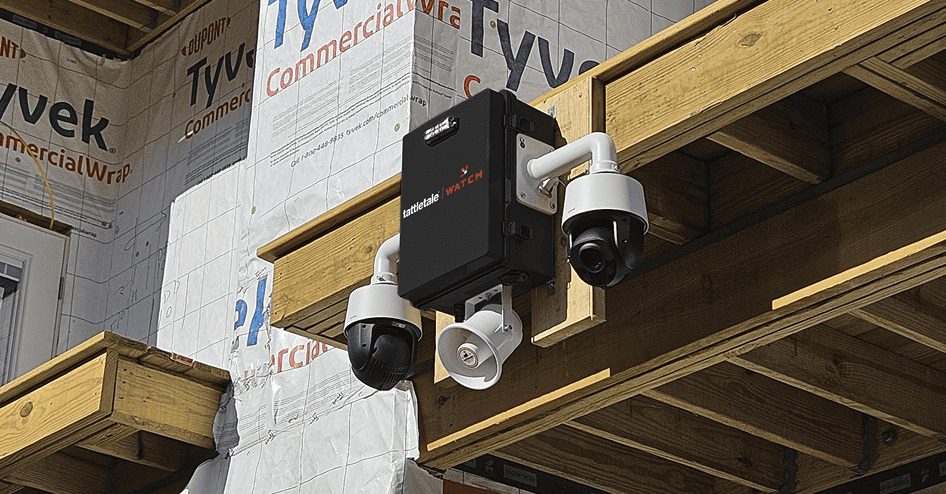
As we said above, the default security setup on most construction sites is a set of cameras mounted on poles around the property line.
These camera systems are designed for one thing: capturing video of the perimeter. They watch for intruders. They record footage. And if a monitoring service sees something suspicious, they notify the site superintendent.
The problem is that fire doesn’t start on the perimeter.
Fire starts inside the structure. It starts when equipment overheats. It starts when insulation foam ignites near a heat source. It starts in areas that exterior cameras are not positioned to see.
By the time flames become visible from the outside of an unfinished building, the fire has already consumed interior materials, spread through open floor systems, and created conditions that make rescue or suppression extremely difficult.
There are three specific failure points with perimeter-only camera monitoring:
- Cameras rely on line of sight. If the fire is inside the structure, behind walls, or on a floor above ground level, the cameras won’t detect it until it is well advanced.
- Monitoring depends on a human watching a feed. If no operator is watching at the moment the fire becomes visible, there is an additional delay before anyone takes action. On weekends and overnight shifts, monitoring attention drops.
- Camera systems are physically exposed and vulnerable. Solar panels, wiring, and connections are often accessible and can be damaged, disconnected, or rendered useless by weather, construction activity, or vandalism.
A camera that records a fire is useful for an insurance claim.
It does nothing to save a worker trapped on the sixth floor.
What Does a Complete Construction Site Fire Detection System Look Like?
A system that detects fire inside the structure, not one that watches the perimeter and waits.
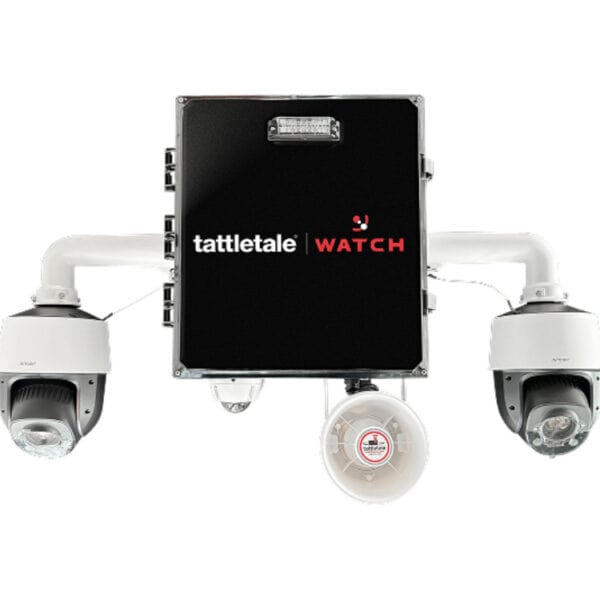
The most effective construction site fire detection pairs two technologies: embedded wireless heat sensors placed inside the structure and AI-powered cameras monitoring the site from the outside.
Neither one alone is enough. Together, they close the time gap.
Embedded Rate-of-Rise Heat Sensors
Rate-of-rise heat detectors trigger an alarm when they sense a rapid temperature change, typically a 10-degree increase within 60 seconds, or when the ambient temperature hits a fixed threshold (around 190 degrees Fahrenheit).
These sensors sit inside the structure.
They don’t need line of sight to a flame. They don’t depend on smoke reaching a detector. They respond to the thermal signature of a fire in its earliest stages, before it becomes visible from the outside.
On a construction site, this is critical. The environment is dusty. Smoke detectors would throw constant false alarms. But heat detection based on rate-of-rise is reliable in these conditions because it responds to temperature changes, not airborne particles.
Wireless versions of these sensors are portable. They don’t require hard-wired installation. They pair with a base unit that communicates over cellular networks, not WiFi, which means they stay online even if there is no internet connection on site.
And because they run on cellular, they are not vulnerable to the same physical disruption as WiFi-based systems. Cutting a cable or disconnecting a router does not take them offline.
AI-Powered Camera Monitoring
Cameras still play a role, but the technology has advanced beyond passive video recording.
Modern AI-powered construction cameras detect specific conditions: a person on site without a hard hat or safety vest, unauthorized access after hours, and increasingly, visible flame detection. Some systems also offer progression camera features, recording time-lapse views of the construction project for documentation purposes.
The camera provides video evidence, visual confirmation, and site-wide awareness.
The heat sensor provides the early detection trigger that a camera physically cannot.
How They Work Together
Here is the sequence when both systems are active:
- A heat source ignites material inside the building.
- The rate-of-rise sensor detects the temperature change within seconds.
- An instant alert is sent via cellular to the site manager’s phone and to the monitoring service.
- The monitoring service pulls up the nearest camera feed for visual confirmation.
- Emergency services are dispatched.
- Workers on site receive notification and begin evacuation.
The time gap shrinks from minutes (or longer) to seconds. That is the difference.
Detection System Comparison
| Feature | Perimeter Cameras Only | Embedded Sensors + AI Cameras |
| Detects fire inside the structure | No | Yes |
| Works in dusty construction environments | N/A (exterior only) | Yes (rate-of-rise, not smoke-dependent) |
| Sends instant alerts | Only if operator sees fire | Yes, automated via cellular |
| Functions without WiFi | Depends on system | Yes (cellular communication) |
| Requires hardwired installation | Often yes | No (wireless, portable) |
| Provides video evidence | Yes | Yes |
| Detection time from ignition | Minutes to hours | Seconds |
| Operates 24/7 unattended | Depends on monitoring service | Yes, with automated alerts |
Frequently Asked Questions
What is the most common cause of construction site fires?
According to the NFPA, the leading cause of fires in structures under construction is cooking equipment. Other top causes include electrical distribution equipment, hot work (welding, cutting, grinding), heating equipment, and arson. Thirteen percent of fires in buildings under construction are intentionally set.
How many construction site fires happen per year in the U.S.?
U.S. fire departments responded to an average of 3,840 fires per year in structures under construction between 2013 and 2017 (NFPA). Combined with fires in structures under major renovation, the total rises to over 6,400 fires per year.
Why don’t construction sites have fire alarms?
Most construction sites do not have operational fire alarm or sprinkler systems because these systems are among the last to be installed and activated before a building receives its certificate of occupancy. NFPA 241 (Standard for Safeguarding Construction, Alteration, and Demolition Operations) provides guidance on temporary fire protection during construction, but compliance varies.
What is a rate-of-rise heat detector?
A rate-of-rise heat detector is a sensor that triggers an alarm when it senses a rapid temperature increase (typically 10 degrees Fahrenheit within 60 seconds) or when the temperature reaches a fixed threshold (commonly 135 to 190 degrees Fahrenheit). Unlike smoke detectors, rate-of-rise heat detectors are reliable in dusty environments like construction sites because they respond to thermal changes, not airborne particles.
What is NFPA 241?
NFPA 241 is the National Fire Protection Association’s standard for safeguarding construction, alteration, and demolition operations. It outlines requirements for fire prevention planning, hot work procedures, temporary fire protection, security, and emergency response on construction sites. Following the 2023 Charlotte SouthPark fire, North Carolina accelerated adoption of updated fire codes aligned with NFPA standards.
What fire detection works best on an active construction site?
The most effective approach combines embedded wireless heat sensors inside the structure with AI-powered exterior cameras. Heat sensors detect fire at its thermal origin. Cameras provide visual confirmation and site awareness. Cellular-based communication ensures alerts reach decision-makers in seconds, regardless of whether WiFi is available on site.
How does cellular fire detection work on a construction site?
Cellular fire detection systems communicate over mobile networks rather than WiFi or landline connections. When a sensor triggers, the alert is transmitted via cellular signal to a monitoring service and directly to designated phone numbers. This approach is more reliable on construction sites where internet connectivity is limited or nonexistent.
Are construction site fire detection systems portable?
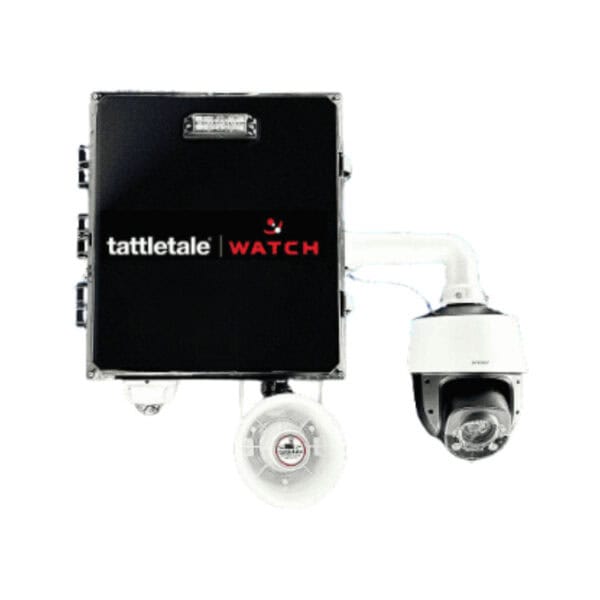
Yes. Wireless, cellular-based fire detection systems (like tattletale PRO) are designed to be portable. They require no hardwired installation. Sensors pair wirelessly with a base unit, and the entire system can be relocated as the project progresses or moved to a new job site when a project is complete.
The Time Gap Is the Problem. Close It.
Regulation is catching up.
North Carolina’s new fire codes represent meaningful progress. Charlotte’s addition of 12 inspectors and a dedicated construction team is a model other cities should follow.
But the gap between where regulations are today and where detection technology needs to be is significant.
A fire prevention plan filed with the fire department does not detect a fire. An inspection that happened last week does not protect workers this weekend.
What protects workers is a detection system that operates around the clock, inside the structure, and sends alerts in seconds.
If you are managing a construction site and relying on perimeter cameras alone, you are relying on technology from the 1990s to protect workers in 2026.
The detection gap is closable. The question is whether you close it before or after something happens.
Learn more about tattletale’s construction site fire detection systems →
Explore the tattletale Wireless Rate-of-Rise Heat Detector →